



Vietnamese Football: 'Each House Lights Its Own Lamp'



Having earned 13 out of 15 maximum points from their recent 5 matches, CAHN solidifies its lead with 48 points after 19 rounds. CAHN is charging toward the title with dominant power, appearing to have no competitors of matching caliber in this season's championship chase.
Most recently, in the match at Gò Đậu Stadium against CLB CATP.HCM, Coach Polking's team easily secured 3 points with a decisive 3-goal victory.
On the continental stage, CAHN is also one of the rare outstanding representatives from V-League to have advanced deeply. If AFC increases the allocation for the AFC Champions League Elite next season, CAHN fully has the opportunity to participate from the playoff, preliminary rounds, or even a direct spot into the group stage.
This is the most prestigious club-level continental competition, but unfortunately, V-League has been absent for too long. In reality, the professional quality, competitiveness, and commercial value of V-League have significantly declined compared to the previous decade.
That is the direct reason why Vietnamese football is gradually losing its standing in Asian tournaments. Although the situation is improving, debates surrounding increasing the number of foreign players remain unresolved. Looking back at the period around the Covid-19 pandemic, the post-first-round group split format was once considered a timely "innovation." The top 8 teams competed for the championship, while the remaining 6 fought to avoid relegation. This format minimized negative "point-giving" matches and heightened competitiveness. Unfortunately, due to objective barriers, this model was not sustained.
Returning to the issue of increasing foreign player quotas to elevate the league's level. This is not a new direction, as we implemented it over 10 years ago. However, accompanying it must be a transformation in referee quality.
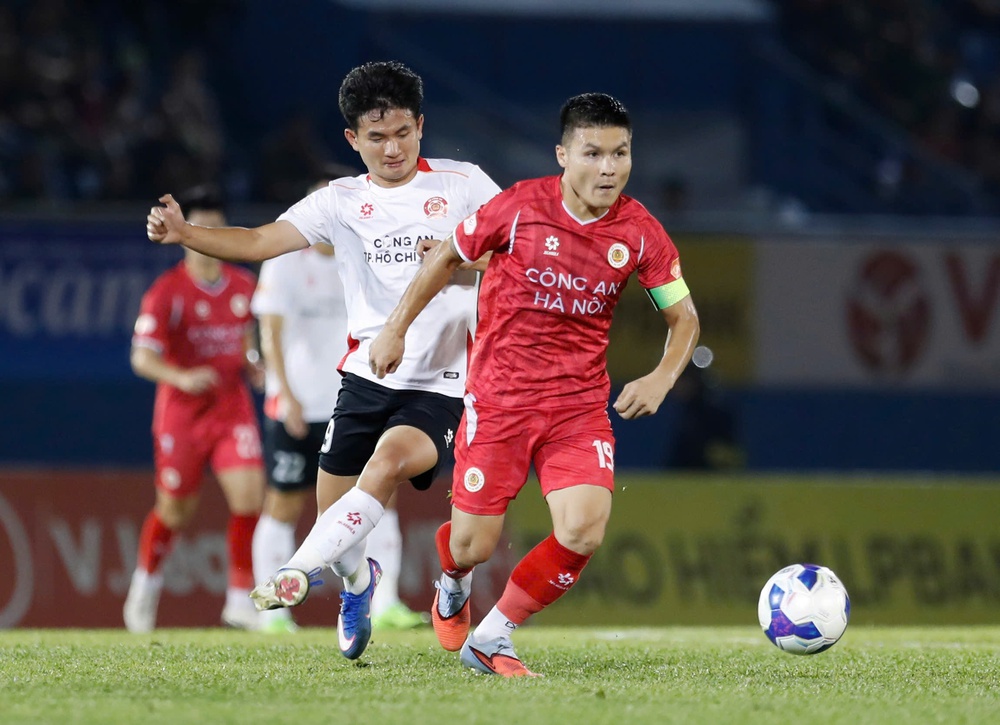
Quang Hải and his teammates at CAHN Club will have the opportunity to participate in continental competitions if they win the V-League this year. Photo: Hoàng Linh
Regarding this matter, VFF Vice President Nguyễn Xuân Vũ stated: "Previously, young players after training lacked playing opportunities and struggled to find positions at clubs. That is why we had to tighten foreign player and naturalized player quotas. But now the context has changed; youth training quality has stabilized, and we can confidently return to an open mechanism. However, any changes require a roadmap of 2 years, 5 years, or 10 years so clubs can proactively prepare. Sudden adjustments risk backlash, as each club has different financial capabilities and ambitions; uniform management cannot be applied."
Ultimately, money is the core of the issue. Look at the national leagues of Malaysia, Indonesia, Thailand, or even Singapore to see how much they invest in football with the support of giant corporations.
Looking back at ourselves, the financial resources for V-League remain a major question. The 2025/2026 V-League hasn't even started, yet the potential championship contenders and relegation spots seem to have already been outlined.
In reality, this is a common scenario for national leagues worldwide, where financial strength and preparation always create clear boundaries. However, the issue for Vietnam's top league isn't about 'knowing the script beforehand,' but how to ensure that differentiation still generates commercial value and professional appeal in each round.
That is the problem organizers need to solve, rather than merely relying on momentary surprises.


Wonderfulshortvideo

My @CLUB needs more fans!


The touch and the pass 😮💨

doku goal today haaland goal today cherki goal today man city 3-0 liverpool premier league news man city news

cherki goal today rayan cherki edit cherki vs liverpool

User esportapi has posted a video.

User esportapi has posted a video.

Just so cool 😎
 Links
Links
 Contact
 App
App


