



The Premier League title race: Arsenal falter but are not yet defeated



Having previously established a safe distance from the rest of the Premier League, Arsenal now face growing doubts about their ability to win the title this season.
However, looking at the overall picture, things are not entirely negative for Mikel Arteta and his team.
Arsenal's biggest weakness
The defeat at Etihad clearly demonstrates the gap between a team approaching the pinnacle and a collective already at championship level. Arsenal did not play poorly; at times they even controlled the game well and created significant pressure. But in top-level football, the difference is often decided in the two penalty areas, where the London club fell short.
Erling Haaland needed just one clear chance to decide the match, while Kai Havertz missed opportunities that could have changed the course of the game. Most notable was the headed chance in stoppage time, when the German striker was in a favorable position but could not hit the target. The image of Mikel Arteta collapsing in the technical area after that moment partly reflected Arsenal's disappointment, not just for one match, but potentially for the entire season.
Arsenal's problem is not a lack of created chances. On the contrary, they have had periods where their attacking play was more coherent than before. But the finishing lacked the necessary cold-bloodedness. Havertz is a player who contributes well to the overall play, with intelligent movement and effective pressing support, yet his finishing ability has not reached the level of a top-tier striker.
Meanwhile, new signing Viktor Gyokeres has not truly convinced anyone yet. Despite a relatively stable scoring record, the Swedish striker has not shown his mettle in big matches. This is precisely the difference compared to strikers like Sergio Aguero, Didier Drogba, or Mohamed Salah who helped their teams win titles in the past.
In reality, Arsenal are in an unusual situation: competing for the title without possessing a truly outstanding striker. Options in attack like Gabriel Martinelli, Gabriel Jesus, or Noni Madueke each have their own qualities, but none has reached the stature of a true "match-decider."
The consequence is that Arsenal struggle to convert chances into goals, especially in major matches. Statistics on expected goals from open play show they are not among the league leaders, reflecting some limitation in their ability to create breakthroughs. When opponents have begun to neutralize set-piece situations, which were Arsenal's strength, this limitation becomes even more apparent.
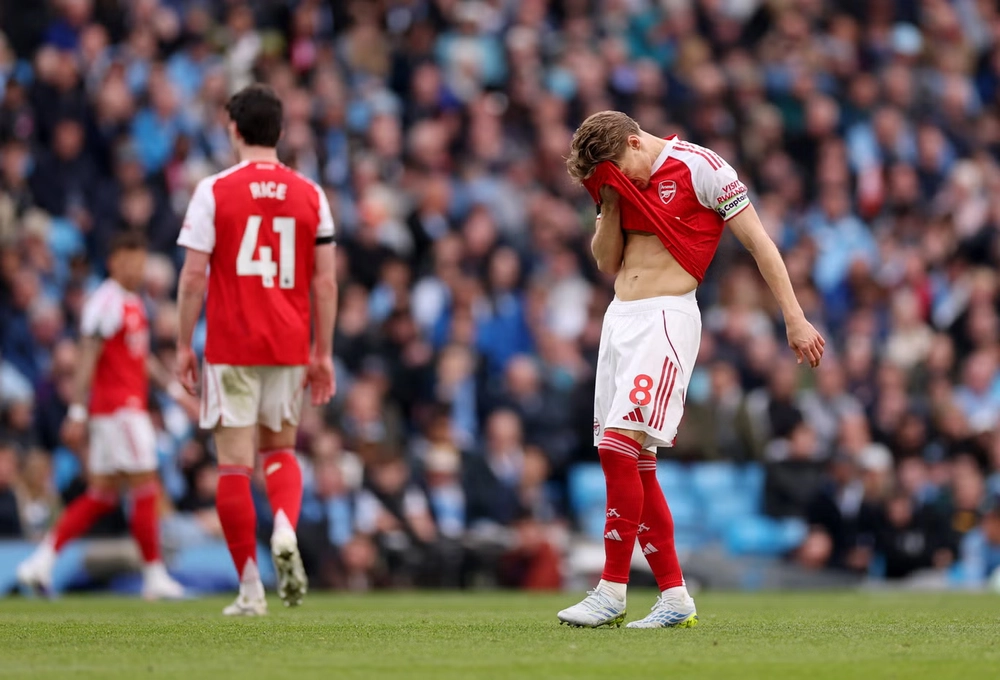
Arsenal are about to be overtaken by Man City, but the title chance remains intact
The opportunity remains intact
Nevertheless, it would be unfair to judge Arsenal solely based on the result. The most positive aspect after the defeat to Man City is the improvement in their style of play. Unlike the cautious and somewhat passive image from previous weeks, Arsenal proactively employed high pressing, controlled the ball better, and were ready to compete head-to-head with their opponent.
Arteta's tactical adjustments, pushing the team higher and enhancing ball circulation, yielded clear results, at least in the first half. Arsenal no longer relied too heavily on set-piece situations but created chances from open-play combinations. This is a positive signal, showing the team still has the ability to adapt and develop when needed.
Of course, the defeat also revealed their limits. After the break, Man City adjusted tactics, controlled the midfield, and gradually imposed their game. As fitness declined, Arsenal could not maintain the initial pressing intensity, exposing gaps for the opponent to exploit. Haaland's decisive goal came precisely from a moment when Arsenal's defensive system was stretched.
Nevertheless, the crucial point is that Arsenal did not collapse mentally. The players' reaction after the match, as well as the support from fans, shows that belief remains intact. Arsenal's upcoming schedule, theoretically, is relatively favorable as they only face teams from the lower half of the table. However, the lesson from the defeat to Bournemouth shows no match is easy. Stability and resilience will be decisive factors, especially under increasing pressure.
Additionally, Arsenal must allocate resources for the Champions League arena, where they are preparing for the semi-finals. This is both an opportunity and a challenge, as a congested schedule could affect the team's fitness and focus. However, if utilized properly, the high-level matches in Europe could also become motivation for Arsenal to maintain their fighting spirit.
Finally, it must be recognized that Arsenal are still in a process of refinement. Compared to Man City, a team that has accumulated experience and resilience over many seasons, they still lack some necessary qualities. But that gap is not insurmountable. Arsenal are faltering, but not yet defeated. And in a race where every small detail can make a difference, the opportunity remains in their hands.


Wonderfulshortvideo

My @CLUB needs more fans!


The touch and the pass 😮💨

doku goal today haaland goal today cherki goal today man city 3-0 liverpool premier league news man city news

cherki goal today rayan cherki edit cherki vs liverpool

User esportapi has posted a video.

User esportapi has posted a video.

Just so cool 😎
 Links
Links
 Contact
 App
App


