



Vietnamese Football: Looking at Others to Reflect on Ourselves



The AFC Champions League Elite this season has seen the spectacular progress of two Southeast Asian clubs: Johor Darul Ta'zim (often shortened to JDT, Malaysia) and Buriram United (Thailand).
While JDT dramatically defeated Sanfrecce Hiroshima (Japan) with an aggregate score of 3-2 over two matches in the round of 16 and narrowly lost 1-2 to the giant Al Ahli (Saudi Arabia) in the quarter-finals, Buriram United, in the round of 16, overcame Melbourne City (Australia) via a penalty shootout (drawing 1-1 after two legs and winning 4-2 on penalties) to advance to the quarter-finals, before narrowly stopping with a 2-3 defeat to Shabab Al Ahli (UAE) after extra time.
Earlier, in the group stage, Buriram United was once the "fear" of this season's K-League representatives, with a 2-1 victory over Ulsan HD FC, the reigning K-League champion, and then a 2-2 draw with Gangwon FC.
While Malaysian and Thai representatives performed so vibrantly in this season's AFC Champions League, Vietnamese football at the club level only participated in the lower-tier AFC Champions League Two, and club CAHN would have at least reached the quarter-finals if not for being awarded a 0-3 loss in the round of 16 first leg due to using an ineligible player, despite actually winning 4-0 against Tampines Rovers.
However, if examined carefully, the achievements of JDT and Buriram United are not truly perfect, and in some aspects, Vietnamese football at the club level does not necessarily have to imitate or follow them at all costs.
The reason for saying this is that both JDT and Buriram United maximized AFC's foreign player regulations to enhance their strength. For example, in the narrow 1-2 loss to Al Ahli in Jeddah, JDT used only one local player in the starting lineup, goalkeeper Syihan Hazmi, and only introduced a few more domestic players like Afiq Fazail and Nazmi Faiz in the second half, while most positions on the field were occupied by foreign players from Brazil, Spain, and naturalized foreigners.
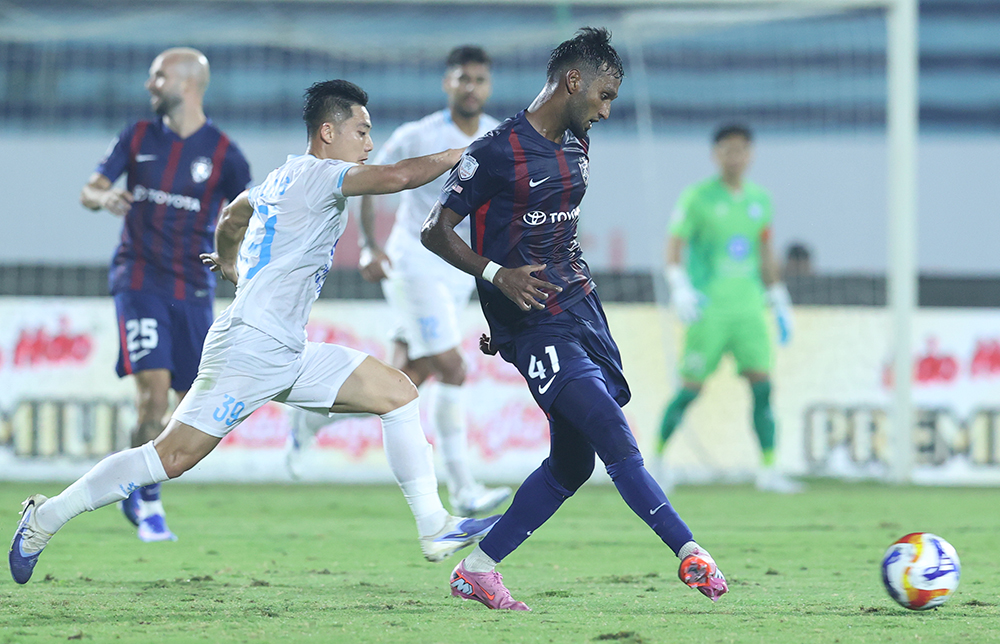
JDT (dark jersey) is a very strong Malaysian club, but its main force consists largely of foreign and naturalized foreign players. Photo: Hoàng Linh
Compared to JDT, Buriram United still relies heavily on foreign strength, with 16 out of 31 registered names being foreigners, but the Thai representative strives to maintain the presence of local players in the lineup, with three domestic players appearing from the start in the loss to Shabab Al Ahli: Pansa Hemviboon, Sasalak Haiprakhon, Supachai Chaided, and later Theerathon Bunmathan was substituted in.
Thus, if only based on the recent AFC Champions League Elite quarter-final match as a benchmark, the proportion of domestic players used by Buriram United was 27%, while this figure for JDT was only 9%, and this also explains why, despite the impressive achievements of Malaysian and Thai football at the continent's most prestigious club-level competition, the performance of their national teams, especially youth teams, does not correspond.
While Thailand had to wait until the final qualifying match to secure a spot in the Asian Cup 2027 finals, Malaysia disappointed even more by deliberately using illegally naturalized players in the qualifiers and was awarded 0-3 losses in two matches against the Vietnamese national team and the Nepalese national team, thereby also missing the finals.
At the U23 level, while Vietnam U23 completed a double gold at the 2025 Southeast Asian U23 Championship and SEA Games 33, and also won bronze at the 2026 AFC U23 Asian Cup finals, Thailand U23 only achieved silver at SEA Games 33 despite having home advantage, and Malaysia U23 only got bronze, and at the 2026 AFC U23 Asian Cup finals, Thailand U23 stopped at the group stage while Malaysia U23 even failed to qualify.
And at the ongoing 2026 Southeast Asian U17 Championship in Indonesia, while Vietnam U17 easily defeated Malaysia U17 4-0 and advanced straight to the semifinals as group winners, unbeaten and without conceding any goals, Thailand U17 was eliminated right in the group stage.
Such statistics show that club strength does not always resonate with the competitiveness of national teams, and Vietnamese football should still be confident and steadfast in the path we have chosen.


Wonderfulshortvideo

My @CLUB needs more fans!


The touch and the pass 😮💨

doku goal today haaland goal today cherki goal today man city 3-0 liverpool premier league news man city news

cherki goal today rayan cherki edit cherki vs liverpool

User esportapi has posted a video.

User esportapi has posted a video.

Just so cool 😎
 Links
Links
 Contact
 App
App


