



Vietnam U17 vs Australia U17: Defeating the reigning champion (19:30 on April 22, TV360 live broadcast of the Southeast Asian U17 semifinal)



Tonight's match is not only a contest for a ticket to the final, but also a major test for the ambition of Vietnamese youth football to reach new heights. Against the reigning champion, coach Cristiano Roland and his team must demonstrate the courage, resilience, and adaptability of a generation that is highly anticipated.
Entering the semifinals as the top team in Group A, Vietnam U17 has reasons to be confident, but cannot afford to be complacent. The 0-0 draw against Indonesia U17 in the final group stage match partially exposed a limitation in their ability to capitalize on opportunities.
That was a match where coach Cristiano Roland's players controlled the game, created numerous dangerous situations but were ineffective against a disciplined defense and an outstanding goalkeeper.
Meanwhile, Australia U17 displayed an impressive performance in the group stage. Three consecutive wins, scoring 15 goals and conceding none are statistics that would make any opponent cautious.
However, it should also be noted that the opponents faced by the Kangaroo team were not truly of high caliber. This makes the actual strength of the reigning champion (Australia U17 has a tradition of three championships when the tournament's predecessor was the Southeast Asian U16) still an unknown factor as they enter a knockout match.
The biggest difference between the two teams lies in physical factors. Australia U17 is always renowned for its robust physical foundation, strong tackling ability, and particularly dangerous in aerial situations.
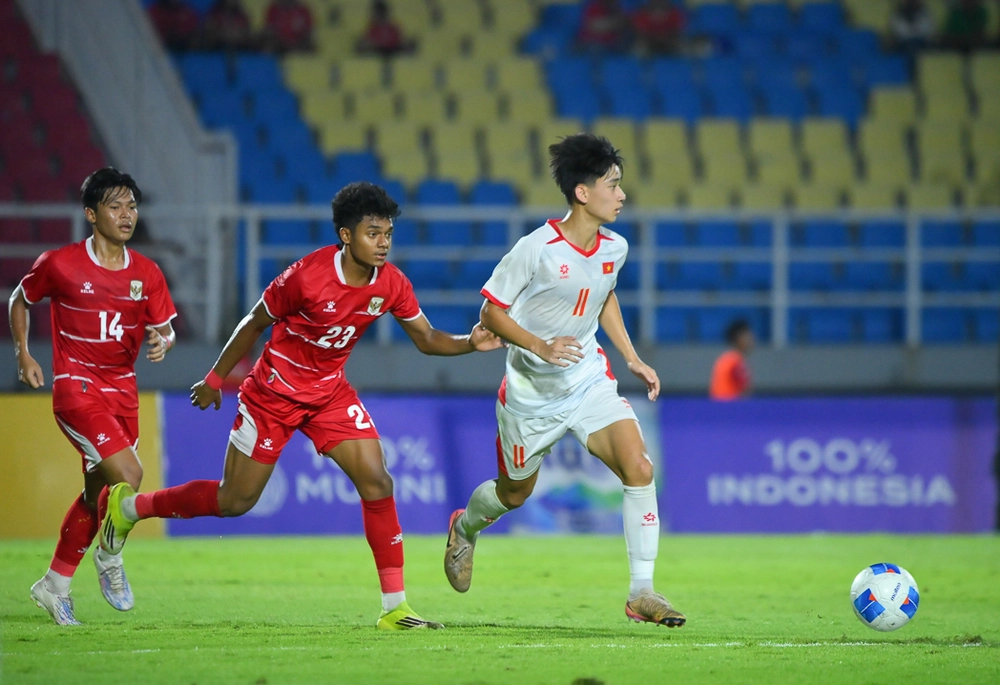
Vietnam U17 (white shirts) possesses a modern style of play, proactive pressing, and is not afraid of physical contact. Photo: VFF
This is precisely a difficult challenge for Vietnam U17, a team that leans towards technique, short combinations, and ball control. If they allow the opponent to impose their style of play, the risk of Vietnam U17 being drawn into individual duels is very high.
However, the promising aspect of Vietnam U17 lies in the philosophy coach Roland has built. It is a modern style of play, proactive pressing, and not afraid of physical contact. Statistics of 50 goals scored and only 4 conceded after 14 matches demonstrate the balance between offense and defense. More importantly, this team no longer has a timid mentality when facing strong opponents, which was once a persistent weakness of Vietnamese youth football.
Therefore, the match against Australia U17 will be the clearest verification. If they maintain a reasonable team formation distance and utilize opportunities well, Vietnam U17 can completely turn Australia U17 into a former champion. Conversely, just a moment of distraction against long balls or set-piece situations could result in a very costly price.
Another factor to mention is the dense schedule of matches. Both teams are entering a tense phase, not only in the Southeast Asian tournament but also aiming for the Asian Championship shortly thereafter.
This requires the coaching staff to make reasonable calculations regarding physical fitness, squad rotation, and tactics. From a positive perspective, facing a strong opponent like Australia is a valuable opportunity for Vietnam U17 to mature. Regardless of the outcome, this remains a quality test before stepping onto the continental stage, where the larger goal is securing a ticket to the U17 World Cup.
But football is not only a story of the distant future. For now, the semifinal is the moment for the young generation to affirm their value. At 17 years old, when skills may not be perfect and experience is still limited, competitive spirit and confidence are the strongest weapons.


Wonderfulshortvideo

ronaldo messi stats ronaldo vs messi edit ronaldo news today messi news today



My @CLUB needs more fans!
The touch and the pass 😮💨

doku goal today haaland goal today cherki goal today man city 3-0 liverpool premier league news man city news

cherki goal today rayan cherki edit cherki vs liverpool

User esportapi has posted a video.

User esportapi has posted a video.
 Links
Links
 Contact
 App
App


