



Burnley - Man City: Pep's team is now truly formidable



This season, Manchester City no longer operates as a smoothly running victory machine like during their previous dominant era, but instead must constantly adjust, experiment, and adapt.
However, precisely within that process, Manchester City has revealed a more formidable version as they enter the decisive phase, a period where Guardiola appears to have established an optimal system with the 4-2-3-1 formation.
Guardiola's journey of experimentation
Early in the season, Manchester City faced several fundamental challenges. The absence of Rodri deprived the midfield of a crucial anchor, while the previously successful 4-3-3 system no longer guaranteed the necessary control.
Following the disappointing 2024-25 season, ongoing issues became evident: excessive reliance on Erling Haaland for scoring, vulnerability during transitional situations, and lack of stability when opponents increased their pressing intensity.
Guardiola initially persisted with the familiar structure, but defeats against Tottenham and Brighton exposed instability. The diminished control in midfield meant Manchester City could no longer maintain their previous dominant game state, while the defense was frequently forced into a reactive stance.
To address this, Guardiola switched to a 4-3-2-1 formation, a system that creates numerical superiority in the central area. By deploying attacking midfielders close together behind Haaland, Manchester City enjoyed a sequence of consecutive victories.
However, as they moved into the mid-season phase, limitations reappeared. The team struggled to maintain stability, especially when the pace of play increased.
The stagnation in January this year was a significant setback. Manchester City lost their sharpness, while Haaland entered a familiar cycle of declining performance. Guardiola continued adjusting with a two-striker setup to share the scoring burden, but this approach exposed weaknesses against well-organized opponents. The defeat to Real Madrid in the Champions League knockout round was a major turning point. Against an experienced opponent adept at exploiting space, Manchester City's attack-oriented system clearly revealed its imbalance.
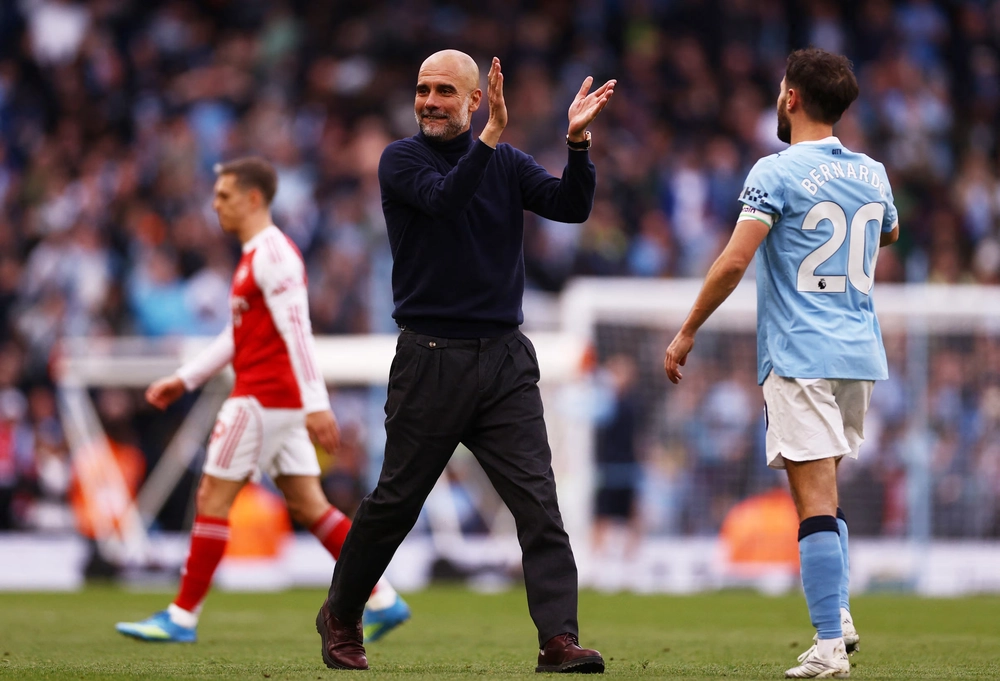
Pep Guardiola has found the optimal system for Manchester City in the decisive phase of the season
The pressing lacked synchronization, the high defensive line was uncontrolled, and the spaces behind were exploited thoroughly. That defeat served as a warning, forcing Guardiola to reconsider his entire tactical approach.
The solution in the decisive phase
After numerous experiments, Guardiola gradually reshaped the team structure with the 4-2-3-1 formation, a system providing clear balance between attack and defense. The core of this operation lies in establishing two holding midfielders behind, creating a foundation for controlling the central space and minimizing risks during opponent counterattacks.
Further forward, the "number 10" role was entrusted to Rayan Cherki, a player with flexible handling and the ability to create breakthroughs in tight spaces. With support from the structure behind him, Cherki was freed from complex defensive duties, allowing him to best utilize his creative qualities. This also improved the connection between midfield and attack, which had been a bottleneck for Manchester City earlier in the season.
Notably, the 4-2-3-1 system not only optimized individual roles but also enhanced tactical flexibility. When without possession, Manchester City could shift to a 4-2-4 structure to increase pressure upfront, while during build-up play, the central midfielders were ready to drop deep, supporting the construction of play from the back line.
The 2-1 victory over Arsenal clearly demonstrated the effectiveness of this system. Despite initial difficulties against intense pressing, Manchester City adjusted promptly. They minimized errors in their own half while effectively exploiting spaces when the opponent pushed their formation forward.
Another notable point is the change in performance metrics. Compared to previous seasons, Manchester City controls possession less, the frequency of high pressing has decreased, but effectiveness in quick counterattacks and penetrating passes has increased. This is a necessary adaptation in a Premier League context increasingly emphasizing physicality and speed.
Guardiola, renowned for his possession-based philosophy, has shown flexibility in adjusting his approach. He no longer strives to maintain a fixed model but aims to optimize existing resources. Maintaining the same lineup for consecutive matches, rare in previous seasons, indicates Manchester City has found the necessary stability.
Overall, Manchester City's journey this season clearly reflects the adaptation process of a major club in an increasingly competitive environment. Changes in personnel, the evolution of opponents, and new tactical demands forced Guardiola to continuously adjust.
And precisely that process has created a different version of Manchester City: more pragmatic, more flexible, yet still retaining their identity of control.


Wonderfulshortvideo
ronaldo messi stats ronaldo vs messi edit ronaldo news today messi news today



My @CLUB needs more fans!
The touch and the pass 😮💨
doku goal today haaland goal today cherki goal today man city 3-0 liverpool premier league news man city news

cherki goal today rayan cherki edit cherki vs liverpool

User esportapi has posted a video.

User esportapi has posted a video.
 Links
Links
 Contact
 App
App


