



All 48 World Cup teams have now played: Asian teams earned 10 points, traditional powers show a split performance



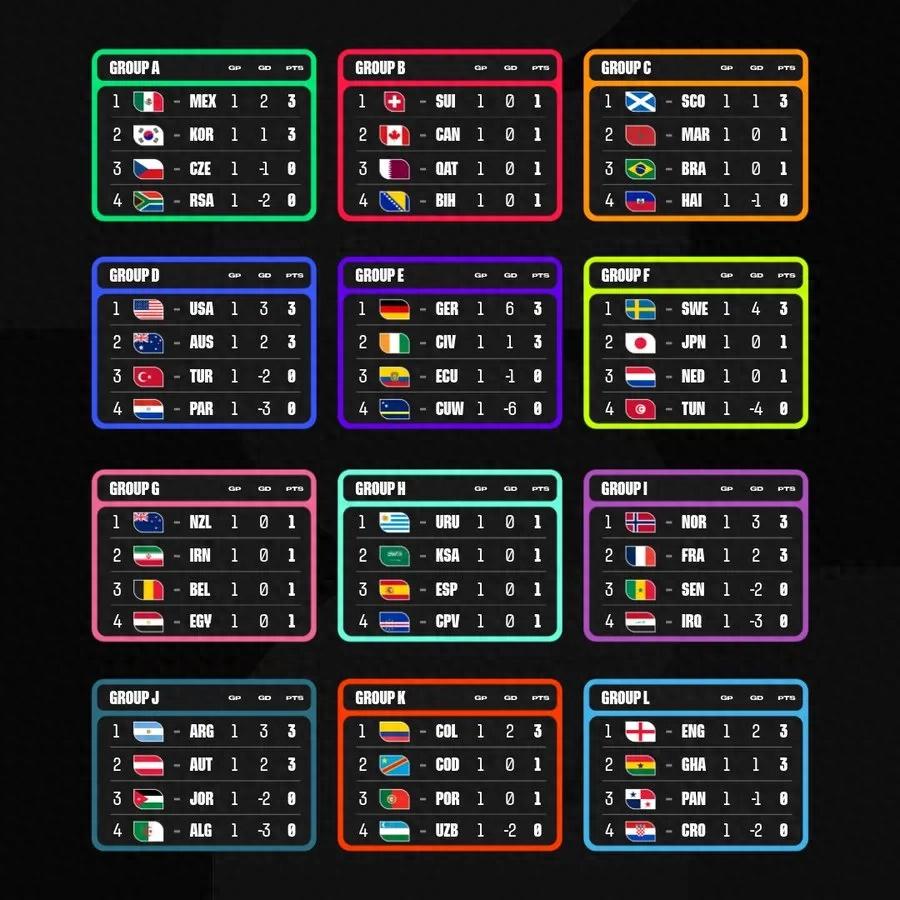
Written by Han Bing The first 24 matches of the inaugural 48-team World Cup have finished. Besides the traditional powerhouses Germany, France, Argentina, and England impressing as title favorites in their opening games, Spain, Brazil, Portugal, and Uruguay were slow starters, creating surprises like Cape Verde, DR Congo, and Saudi Arabia. Additionally, all three host nations remained unbeaten, extending the tradition that hosts rarely lose their debut match. The collective rise of Asian football and the general decline of South American teams were the biggest highlights of the first round. Despite big scorelines such as Germany 7-1 Curaçao, Sweden 5-1 Tunisia, Norway 4-1 Iraq, and the USA 4-1 Paraguay, most matches indicated a narrowing gap between strong and weak teams in world football.

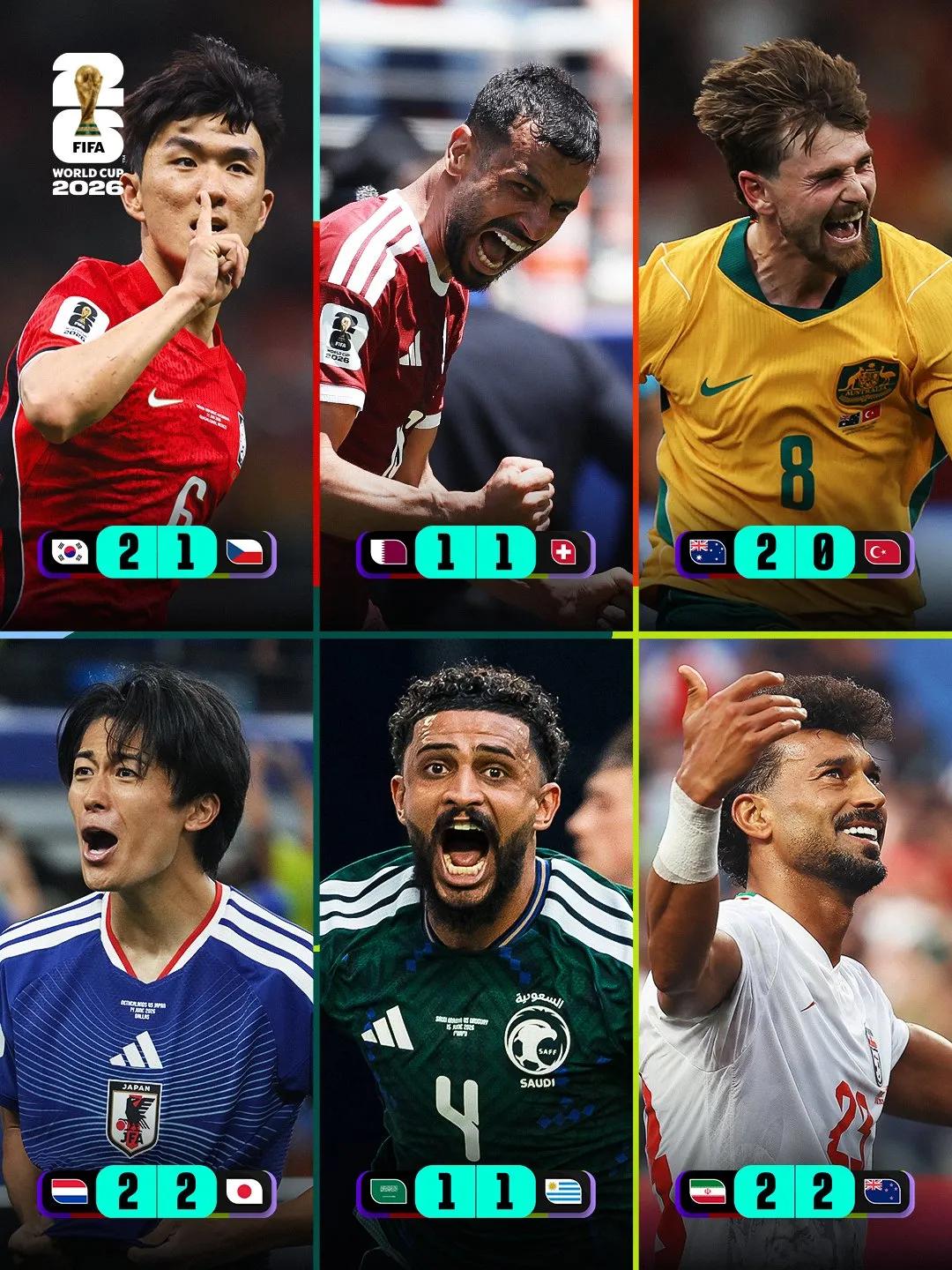
The biggest takeaway from the first round of the USA-Mexico-Canada World Cup was the impressive performance of Asia, traditionally the weakest confederation in World Cup history. South Korea and Australia defeated Czech Republic and Turkey respectively, while Qatar, Japan, Saudi Arabia, and Iran drew with Switzerland, Netherlands, Uruguay, and New Zealand in turn. The nine Asian teams in the first round recorded 2 wins, 4 draws, and 3 losses for a total of 10 points, averaging 1.11 points per game—higher than Africa and Oceania (1 point each), slightly behind host-confederation CONCACAF (1.17 points), and trailing the traditionally stronger South America (1.33 points) and Europe (1.69 points).
Asian teams went unbeaten in their first six matches with 2 wins and 4 draws. Apart from South Korea's victory over Czech Republic and Iran's draw with New Zealand, the other four matches saw lower-ranked Asian teams avoid defeat against higher-ranked European or American opponents. Qatar, who lost all three group-stage matches four years ago, held Switzerland (37 places higher in the rankings) to a draw; Saudi Arabia drew with Uruguay (45 places higher); Japan drew with the Netherlands (10 places higher). All nine Asian teams scored in their opening match, the first time this has happened since the 2006 World Cup. Back then, only four Asian teams participated, with a first-round record of 1 win, 1 draw, and 2 losses.
Even though Iraq, Jordan, and Uzbekistan lost, the matches were not one-sided; they featured back-and-forth play rather than the previous lopsided scorelines like 0-5 or 0-8. Moreover, if Iran had not faced unfair treatment before the match and had prepared normally, Asian teams might have added another victory.

World Cup expansion has made group-stage advancement easier, and the performances of traditional powerhouses in the first round were polarized. Germany delivered the biggest win of the round (7-1), while France, Argentina, and England—relying on their star players Mbappé, Messi, and Kane—secured big wins to lay the foundation for advancement. Brazil, missing Neymar, was held to a draw by Morocco, a team of similar ranking, which was somewhat expected. However, the Netherlands, Belgium, Spain, Uruguay, and Portugal all disappointingly drew with lower-ranked opponents.
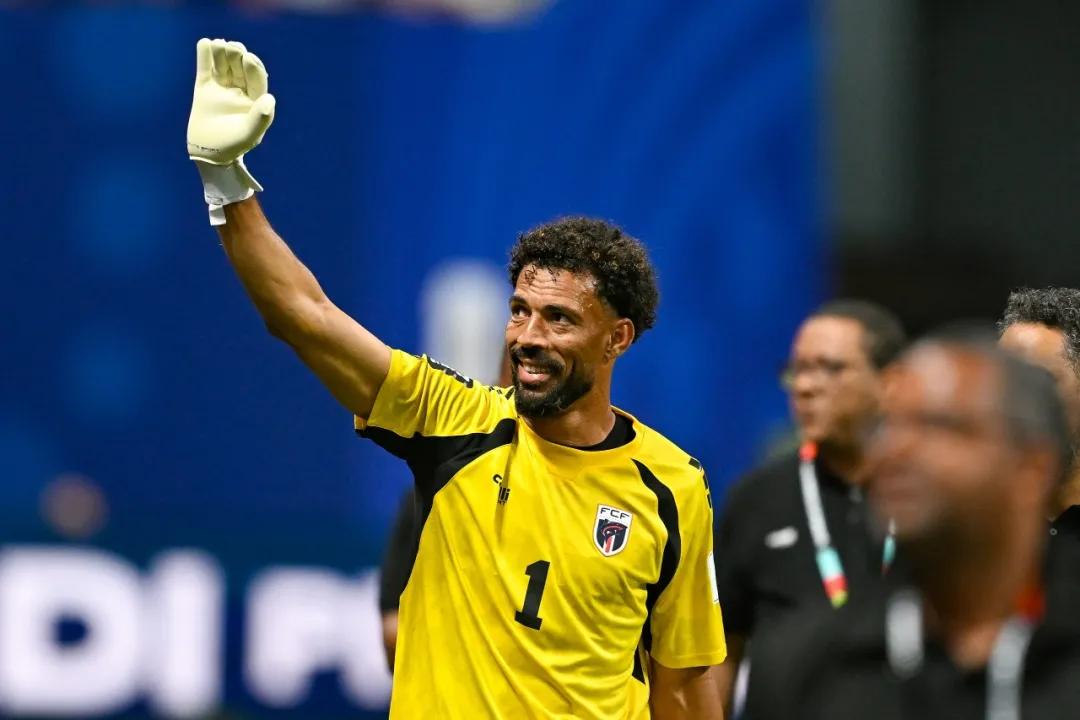
Spain, the pre-tournament title favorites, were held to a draw by Cape Verde, ranked 65 places lower—the biggest upset of the World Cup so far. Spain had 27 shots without scoring. Uruguay and Portugal also drew with Saudi Arabia and DR Congo, respectively, both ranked at least 35 places lower, and showed a lack of attacking potency, which was disappointing. Although third place in the group still offers a chance to advance, failing to win the opening match could force these slow-starting teams to face stronger opponents earlier in the knockout stage, potentially leading to an earlier exit.
The first-round performances also affected expectations for the major title contenders. After the first round, Spain dropped from first to second in the championship odds, while France, after their big win, rose to first. England remained steady in third, Argentina climbed from sixth to fourth, while Brazil and Portugal, which underperformed, both dropped in the rankings. Meanwhile, Morocco, the USA, and Mexico—who performed well in the first round—also saw their odds rise. Along with Norway and Japan, whose rankings stayed unchanged, these teams form an intriguing group of potential dark horses.

Before the tournament, there were widespread concerns that expansion would lower the competitive level of the group stage, leading to many lopsided scorelines and diminishing the quality of the World Cup. Although there were five matches with a margin of three or more goals—most notably Germany's 7-1 win over Curaçao—the teams that benefited from expansion mostly performed surprisingly well. Apart from Curaçao's heavy defeat, the World Cup debutants included Cape Verde, who held top favorites Spain to a draw, and Jordan and Uzbekistan, who lost by just two goals against European or American mid-tier teams ranked at least 35 places higher.
Among the 12 participating teams ranked outside the top 48 in the world, the first round yielded 1 win, 5 draws, and 6 losses, with an unbeaten rate of 50%. Only four teams—Curaçao, Iraq, Jordan, and Uzbekistan—conceded three or more goals. Of the 24 first-round matches, most were between teams with significant gaps on paper. Sixteen matches featured a ranking difference of 20 or more places, and four of the five matches with a goal margin of three or more came from those. However, there were also eight upsets (1 win, 7 draws) where lower-ranked teams held or beat higher-ranked opponents, accounting for 50% of those matches.
Haiti lost by just one goal to Scotland, ranked 39 places higher; New Zealand and Cape Verde both drew with opponents ranked 65 places higher; Saudi Arabia (45 places), DR Congo (41), Qatar (37), Bosnia (34), and Egypt (20) followed closely, while Ghana even defeated Panama, ranked 39 places higher. Of the 24 matches, 13 had a goal difference of one or less—over 50%—and 19 had a difference of two or less, reaching 79%. This clearly shows that the actual competitive gap between teams has narrowed significantly.


Wonderfulshortvideo
real madrid news today barcelona news today la liga news today lamine yamal goal today lamine yamal assist



WHAT A WEEKEND for Godolphin
It’s like watching the Mona Lisa being painted 🤯

Valid crash out‼️

haaland goal today haaland edit haaland injury news haaland vs ipswich man city 3-2 ipswich town

The walk in question 😮💨

🔉How to travel a horse to the races!
 Links
Links
 Contact
 App
App


