



Vietnam vs Malaysia: A Battle of Wits Behind the Offensive Thrusts



Vietnam has conceded only one goal in the group stage, while Malaysia's defense has kept clean sheets in two out of four matches. However, both teams actually have worrying "cracks" to address...
The key question is which coach—Kim Sang Sik or Tan Cheng Hoe—can better mask his own weaknesses while forcing the opponent to expose theirs more often.
Vietnam's Defense: Don't Rely Too Much on the Numbers
10 points, top of Group A, 13 goals scored, and just one conceded. If defense were judged by statistics alone, Vietnam would have little to complain about. But considering what actually happened on the pitch, Coach Kim Sang Sik has every reason to be cautious ahead of the away trip to Malaysia.
The goal conceded against Cambodia exposed a recurring issue: Vietnam's ability to control the space behind the defensive line and their reaction in the first seconds after losing possession. A weak pass from Phạm Xuân Mạnh put Nguyễn Thành Chung in a passive position. Then Xuân Mạnh himself failed to track Bento, allowing the Cambodian striker to break through and score the equalizer. At times, goalkeeper Lê Giang Patrik had to proactively leave his box to handle the ball, compensating for the gaps left by the defenders ahead. The fact that this goalkeeper is still not fully fluent in Vietnamese communication could also be a concern.
After the match, Nguyễn Thành Chung admitted that the team had lost focus. That honesty is more important than pinpointing a single individual to blame. If the goal is dismissed solely as Xuân Mạnh's mistake, Vietnam risks overlooking a larger issue: the defensive system has not always maintained its coordination.
Compared to Cambodia, Malaysia has better transition play, players with enough speed to attack the space behind Vietnam's full-backs, and most importantly, the mindset of a team that knows a single mistake can create a turning point. Therefore, Kim Sang Sik's challenge is not simply to "patch" one position. He must adjust how the entire system reacts when possession is lost.
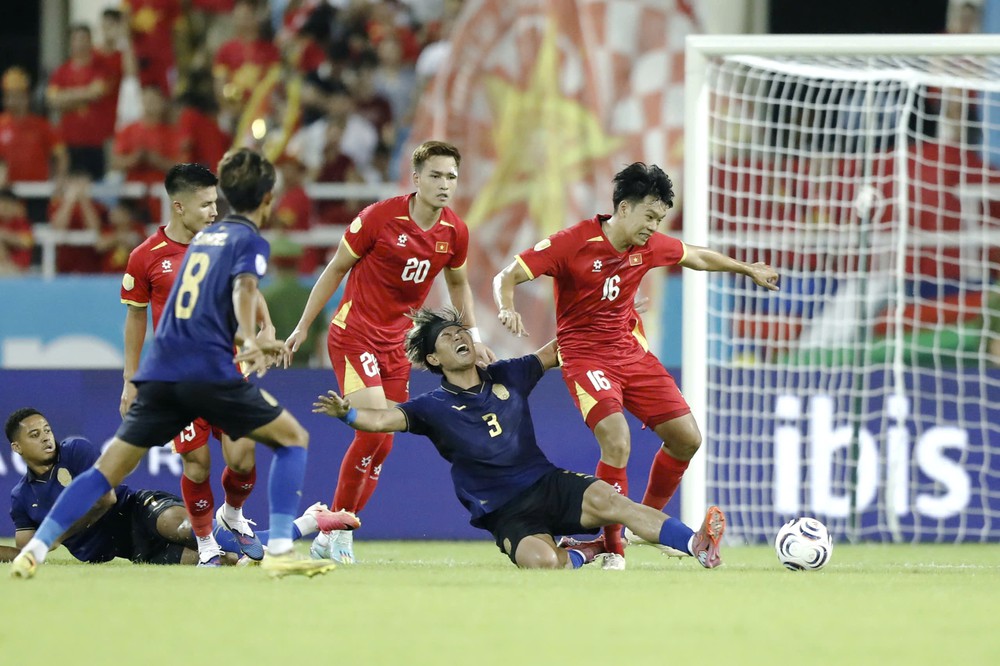
Vietnam's defense has conceded only one goal, but it remains a cause for concern. Photo by Hoang Linh
Vietnam may continue to dominate possession, push high, and apply pressure. But every time the midfield loses the ball, a protective layer must immediately appear in front of the defense. The full-backs also need to time their forward runs carefully, because if they simultaneously leave space behind, Malaysia will get exactly what they want: a corridor for counterattacks.
In other words, Vietnam doesn't need to defend deeper, but they need to defend smarter.
Malaysia: Is Ubaidullah a Solution or a Problem?
The 22-year-old center-back is one of Malaysia's most notable players at the 2026 ASEAN Cup. He not only defends but also plays a special role in building play from the back. In Tan Cheng Hoe's 4-3-3 system, Ubaidullah is the starting point for many attacks from deep. The numbers back this up: he averages around 64 accurate passes per match, with a 91% completion rate. His ball control and defensive stats are also very high according to Mid Block data.
But sometimes, a player's biggest strength can also be what opponents exploit. Ubaidullah is good on the ball, reads situations well, and passes accurately, but his one-on-one duels are not his forte. His duel rating stands at 40.6 points, significantly lower than the average for defenders. In the match where Malaysia lost 1-3 to Vietnam in the Asian Cup 2027 qualifiers last March, this center-back won only 5 out of 13 duels.
This is data that Kim Sang Sik can turn into a tactical challenge. Vietnam doesn't necessarily need to bypass Ubaidullah with intricate combination play. A more direct approach could be more effective: get the ball into areas that force the Malaysian center-back to engage in physical contests.
Nguyễn Xuân Son is the ideal weapon for this strategy. The Vietnamese striker's strength, ability to hold off defenders, and dueling skills can force Ubaidullah out of his comfort zone. At that point, the issue is no longer whether Xuân Son wins the duel or not. What matters more is the space that opens up after the contest. A center-back pulled out of position often drags the entire system out of shape. And if one link shifts half a beat too slowly, players like Quang Hải, Hoàng Đức, Đình Bắc, or Hoàng Hên can capitalize.
Tan Cheng Hoe understands this. So his task is not just to ask Ubaidullah to play more solidly. Malaysia needs to create a protective shield around the young center-back, minimizing the number of times he has to face Xuân Son directly. If Vietnam wants to turn Ubaidullah into a weakness, Malaysia will try to turn him back into a strength: a center-back with time, space, and support to utilize his reading of the game, passing, and organization.
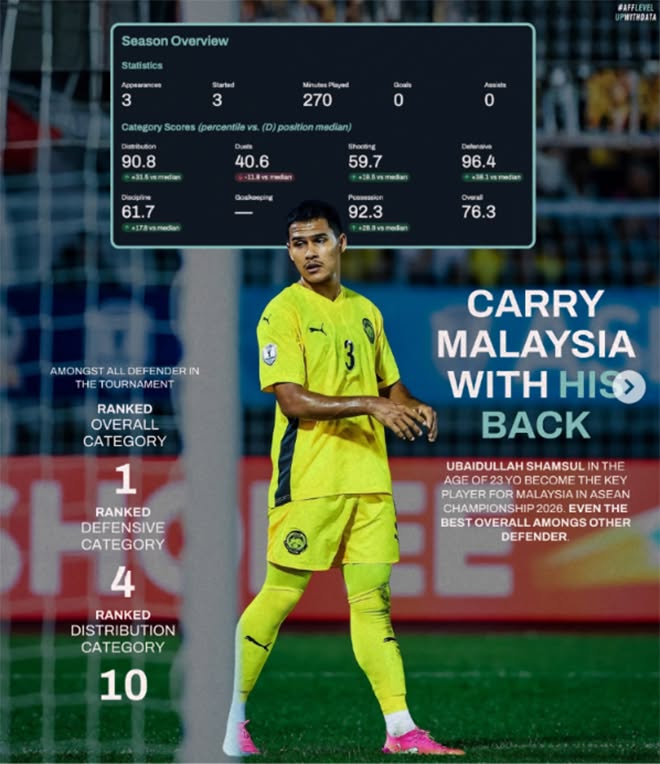
Ubaidullah has many impressive stats, except for duels. Photo by Midblockstats
Who Will Protect Their "Achilles' Heel" Better: Kim Sang Sik or Tan Cheng Hoe?
For Kim Sang Sik, high pressing is a worthy weapon. Vietnam can apply pressure as soon as Ubaidullah receives the ball while blocking his passing lanes to the midfield. If they succeed, Malaysia will struggle to build from the back. But pressing is only effective when the team maintains its shape. If three attacking players push up but the midfield doesn't follow, Vietnam's defense will be pulled out of its safe zone. Then Malaysia could turn Vietnam's pressure into space for counterattacks.
Therefore, Kim Sang Sik probably doesn't need a Vietnam that presses frantically. He needs a Vietnam that knows when to smother and when to drop back. That's also a way to reduce the risk of repeating errors like those against Cambodia.
Tan Cheng Hoe faces the opposite problem. If Malaysia drops too deep, they'll hand control to Vietnam and put their defense under siege. But if they push too high, the space behind will become a gift for Xuân Son and his supporting cast.
A reasonable solution might be a Malaysia that defends deep but not passively. They need to keep a short distance between midfield and defense, limiting Vietnam's space to play through the middle, while waiting for transition moments. That means Malaysia will try to drag Vietnam into a match where Kim Sang Sik's team must be patient. The more impatient Vietnam becomes, the more likely they are to push forward unbalanced. The more they lose possession when unprepared, the greater the counterattack threat.
Conversely, Kim Sang Sik might want to turn that very patience into pressure on Malaysia's defense. If Vietnam repeatedly sends the ball into Ubaidullah's area, stretches the defense, and forces Malaysian midfielders to drop deep, the home team will gradually lose their ability to organize counterattacks.
That's why this semifinal may not be decided by the team with the stronger attack, but by the team that manages risk better. Vietnam has a more experienced defense and a better defensive record, but they need to turn the statistic of just one goal conceded into genuine solidity. Malaysia has Ubaidullah as a foundation, but must protect this young center-back from the direct pressure of Xuân Son. In a matchup like this, the winner may not be the team that creates more chances, but the one that exposes its weaknesses the least in decisive moments.
Aerial Balls Are Not Malaysia's Strength
In terms of physical build, Malaysia's defense is not outstanding. Starting goalkeeper Arzi Ghani is only 1.77m tall—quite modest by modern standards. The center-back pair of Rodney (1.81m) and Ubaidullah (1.82m) is decent but not dominant. Malaysia's tallest player is actually substitute goalkeeper Haziq Aiman (1.92m).
For comparison, all five of Vietnam's forwards are 1.80m or taller, with Xuân Son (1.85m) and Tài Lộc (1.88m) standing out. In set-piece situations, they can also deploy Đoàn Văn Hậu (1.85m), Bùi Hoàng Việt Anh (1.84m), or even the "tall pole" Đinh Quang Kiệt (1.95m).


Wonderfulshortvideo
haaland news today haaland transfer real madrid news today barcelona news today


Two goals and an assist ⚡️
The best saves from MD3 and MD4 👏

User VictoryVox has posted a video.
User esportapi has posted a video.
From relaxation to domination 😮💨
messi crying messi last game argentina messi enzo fernandez messi farewell edit messi edit ronaldo portugal
 Links
Links
 Contact
 App
App


